
Family Legends – Fact or Fiction
Horton Howard’s friend and business associate, Thomas Rotch, attended Annual Meeting in Mount Pleasant. There was much illness in the area, with many dying of bilious fever (also known as malaria or yellow fever.) Thomas fell ill and died on September 14, 1823. After Thomas’ death, there are no records of Horton’s efforts toward Abolition. It seems odd to me that he would suddenly lose interest in work that he had considered important. Did he continue efforts with someone who had not saved letters like Thomas Rotch? Or did his activity become clandestine? We may never know the answers to those questions unless someone finds a trove of letters somewhere in an attic or among as yet undocumented archives of a library or other repository.
My great-aunt, Marjorie Patterson Burns wrote a short family history of tales she had heard from her parents, grandparents, and other family elders. According to her writing, Horton Howard was involved in the Underground Railroad, although there is no known proof of this family legend. Was he actually involved, and if so what role did he play?
On a recent trip to Ohio, I looked for circumstantial evidence to consider the possibility that Horton may have been involved in this work. I made a point to find out more about abolition and Underground Railroad efforts in Ohio. We first detoured to Harper’s Ferry, West Virginia. Our next stops were Mount Pleasant, across the river from Wheeling; the Harriet Beecher Stowe House and the National Underground Railroad Freedom Center, both in Cincinnati; the Rankin House in Ripley; and Spring Hill, Thomas Rotch’s home, in Massillon, Ohio. All of these places provided information about the work of abolitionists, and the extensive network of the Underground Railroad. None provided hard proof of Horton Howard’s involvement in assisting Freedom Seekers.
We know that Horton had interest in the cause. He grew up in a Quaker community that pursued freedom for those they had held in slavery. When that proved impossible in North Carolina, Horton led his community of Quakers from a life of comfort to one of pioneering hardship in the Northwest Territory in the area that became Mount Pleasant, Ohio. That town was known to be part of the extensive Underground Railroad. (the map below is from a sign at the John Ranking House in Ripley, Ohio.)
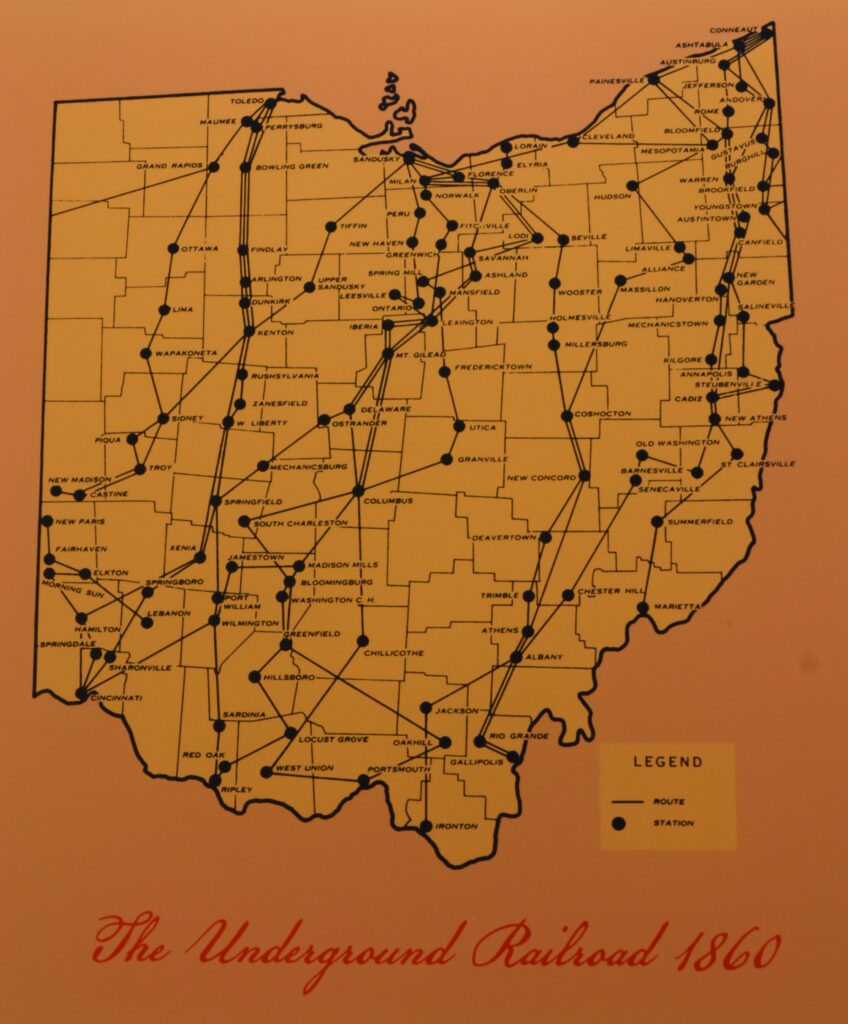
Horton was active in abolition work, and wrote, more than once, to his friend and business associate, Thomas Rotch. Asking for his help such as presenting memorials, or petitions, to Congress on the issue. Rotch was a known abolitionist and his home in Massillon, Ohio was a known safe house, or way station, for Freedom Seekers travelling from the south to Canada.
Thomas Rotch’s records include a letter from Thomas Coffin that mentions Horton Howard. Although nothing is said in that letter about the work of abolition and the underground railroad, many members of the Coffin family were Abolitionists and active in the Underground Railroad. Horton also knew B. W. Ladd, who is not known as an abolitionist, but who had purchased 50 acres of land near Sandusky so that free blacks could settle there. We’ve already heard that this experiment did not go well, as nearby white men attacked and chased away these new settlers. Some of them were so frightened that they returned south, to the bonds of slavery.
After Horton moved away from Mount Pleasant, he often returned to attend meetings of the Society of Friends, to conduct business, or take his children to stay with friends or relatives so that they could attend school. The Quaker community was small and close-knit, so he had opportunity to know Benjamin Lundy, who lived in Mt Pleasant and was an ardent Abolitionist and founder of newspapers supporting that cause. Benjamin was a member of Horton’s extended family. Benjamin’s wife’s brother was married to Lydia Stanton, who was the sister of David Stanton (Edwin McMaster’s father). David, Lydia, and their siblings were cousins of Horton’s mother, Ruth Stanton, making them first cousins once removed to Horton. The Stanton family was another one with many involved in the underground railroad. Horton also remained in communication with Micajah Dillingham. Micajah’s son, Richard, was arrested for helping escaped slaves. He was imprisoned in 1849 and died of cholera in a Tennessee jail in 1850.
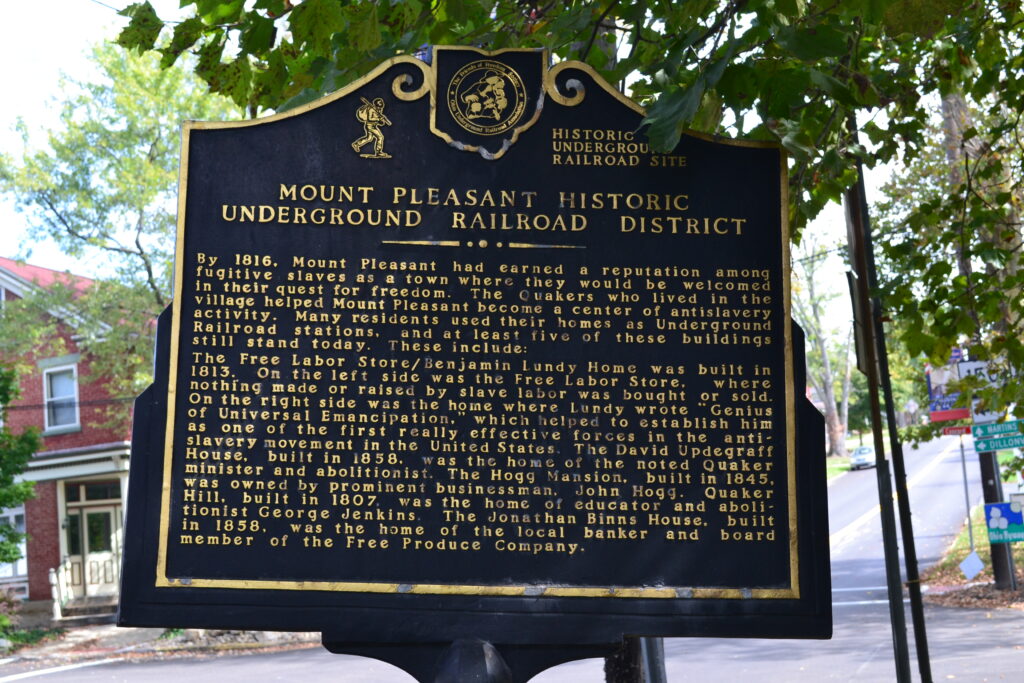
Horton also had opportunity to transport freedom seekers from one stop to another stop on the Underground Railroad. As a land agent, he travelled throughout Ohio. His travels often included visits to other Quaker meetings, where he might have found sympathetic people to help the travelers on their way.
After he became involved with botanic medicine Horton travelled into Kentucky and places further south. He often returned via Cincinnati, another stop on the network of the Underground Railroad. Cincinnati, and other towns in southernmost Ohio were on the Ohio River, directly across from Kentucky. Freedom seekers would try to elude the trackers and dogs pursuing them by crossing the river. In those days, before dams were built, the river was shallower and narrower, making escape relatively easy.
None of this proves that Horton Howard participated in the Underground Railroad. Documentation does prove that he was interested in the cause, that he had connections to others who worked on this effort, and he had ample opportunity to be involved. This amount of circumstantial evidence allows me to consider it not outside the realm of possibility that this family legend is based in truth..
Comments
Family Legends – Fact or Fiction — No Comments
HTML tags allowed in your comment: <a href="" title=""> <abbr title=""> <acronym title=""> <b> <blockquote cite=""> <cite> <code> <del datetime=""> <em> <i> <q cite=""> <s> <strike> <strong>